
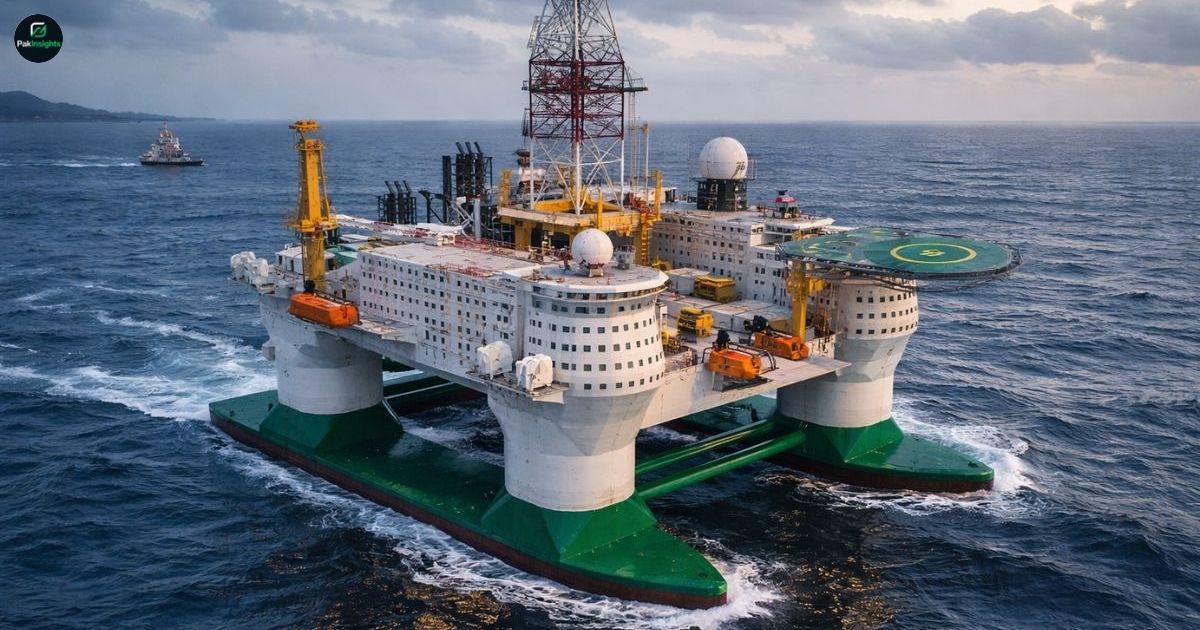
World’s First Floating Island by China: A Leap in Marine Science marks a new era in ocean innovation. The Open-Sea Floating Island is an ultra-large marine research platform designed for deep-sea exploration. It combines advanced marine science and resources monitoring with cutting-edge technology and engineering.
This floating marine research facility includes a semi-submersible twin-hull design, allowing full-scale testing of deep-sea equipment weighing hundreds of tons. The platform can operate at depths of up to 10,000 meters. It also supports offshore oil and gas facilities and deep-sea mining systems. Shore-based laboratory support ensures continuous scientific research and data collection.
Led by Shanghai Jiao Tong University (SJTU), the project is part of China’s major science and technology infrastructure initiative. Researchers aim to study marine ecosystems, seasonal changes, and the evolution of life in extreme ocean environments. The platform also improves typhoon forecasting accuracy, enhancing disaster prevention and mitigation. Scientists expect that this facility will accelerate commercial marine resource development.
The floating island integrates environmental monitoring, marine equipment testing, and scientific exploration into a single, efficient platform. Experts say the project demonstrates China’s commitment to technology and innovation in ocean engineering.
In conclusion, the World’s First Floating Island by China: A Leap in Marine Science sets a global benchmark. It advances marine research, supports offshore infrastructure, and strengthens environmental monitoring, promising a brighter future for ocean exploration.