
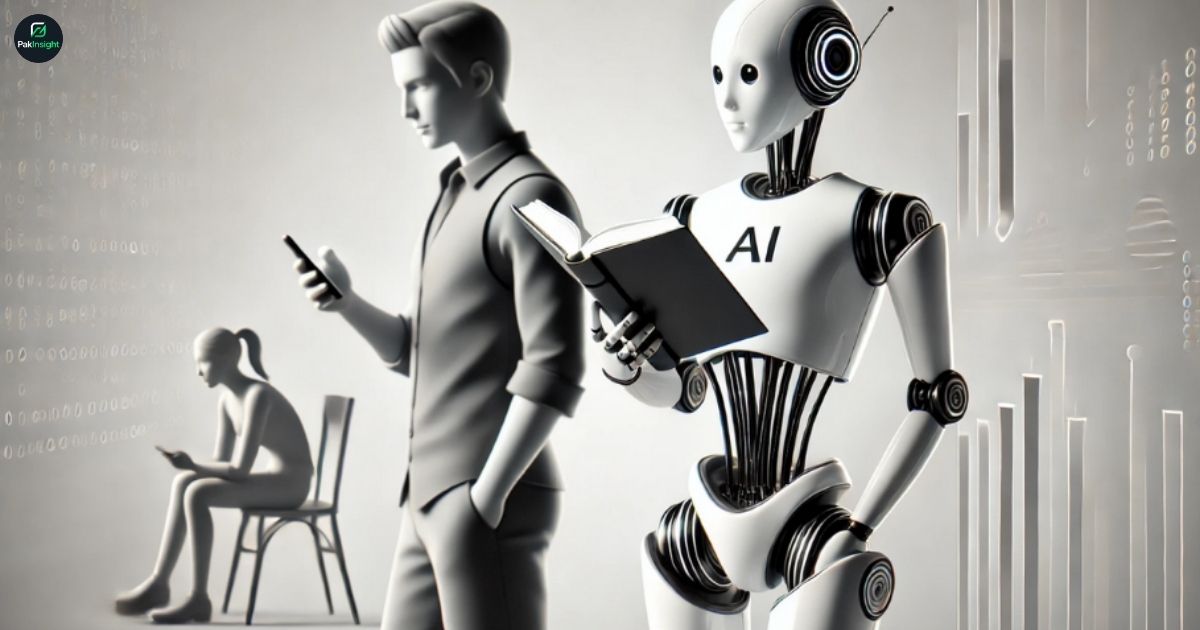
Experts are raising concerns that rapid use of artificial intelligence tools could contribute to AI cognitive decline, as instant answers begin replacing deeper thinking and problem-solving skills among users worldwide, including in Pakistan.
The warning comes amid growing reliance on AI chatbots and search tools that provide immediate responses to complex questions. While these systems improve efficiency, researchers say they may also reduce people’s natural ability to question, analyse, and learn independently.
Growing concern over reduced critical thinking
Experts linked to institutions such as the Royal Museums Greenwich have warned that overdependence on AI may weaken essential cognitive habits. They argue that when users consistently rely on instant solutions, they risk losing the mental effort required for reasoning and evaluation.
Paddy Rodgers, director of the museum, recently highlighted that scientific progress throughout history depended on human curiosity and persistence rather than instant answers. He said early astronomers and researchers built knowledge through observation, trial, and error instead of automated assistance.
According to him, replacing this process with AI-generated summaries may weaken the intellectual discipline that drives innovation.
AI tools are changing how people learn and think
Experts also point out that AI systems are reshaping how students and professionals approach learning. Instead of exploring problems step by step, many users now rely on generated answers without verifying sources or understanding the logic behind them.
Academic voices, including researchers from institutions such as the London School of Economics, warn that this trend could lead to “cognitive outsourcing.” This term describes the habit of handing over thinking tasks to machines instead of using personal mental effort.
Dr. Anuschka Schmitt from the institution noted that conversational AI tools have made it easier for users to avoid intellectual strain in both education and daily work. She warned that long-term dependence may affect memory retention and learning development.
Similarly, educators at Oxford Brookes University have emphasized that while AI can support learning, it should not replace independent thinking. They suggest students use AI as a guide rather than a solution provider.
Benefits remain, but concerns are growing
Despite these concerns, experts agree that AI still plays a powerful role in modern science and innovation. For example, breakthroughs like protein structure prediction using systems developed by Google DeepMind have already transformed medical and biological research.
Industry leaders such as Reid Hoffman also support the idea of using AI as a collaborative tool. He believes AI should challenge human ideas rather than replace human reasoning entirely.
However, experts stress that balance is essential. They argue that AI should enhance human intelligence, not replace the effort required to develop it.
The risk of over-reliance on AI systems
Researchers warn that modern AI tools are changing how people access information. Unlike traditional platforms such as Wikipedia or academic databases, AI systems often provide direct answers without linking users to original sources.
This shift, experts say, may reduce verification habits and increase dependence on unverified summaries. Over time, this could weaken the ability to critically assess information.
In countries like Pakistan, where digital adoption is rapidly increasing, experts believe awareness is crucial. Students, professionals, and content creators are increasingly using AI tools for writing, research, and problem-solving.
While this improves productivity, experts caution that excessive reliance may gradually reduce analytical skills if not managed carefully.
Finding a balance between AI and human thinking
Experts recommend a balanced approach to prevent AI cognitive decline. They suggest using AI as a supportive tool rather than a decision-maker.
Key recommendations include verifying AI-generated information, practising independent research, and maintaining traditional learning habits such as reading and problem-solving without digital assistance.
As AI continues to evolve, experts believe the future will depend on how humans choose to use these tools. Responsible usage may enhance intelligence, while overdependence could weaken essential cognitive abilities.