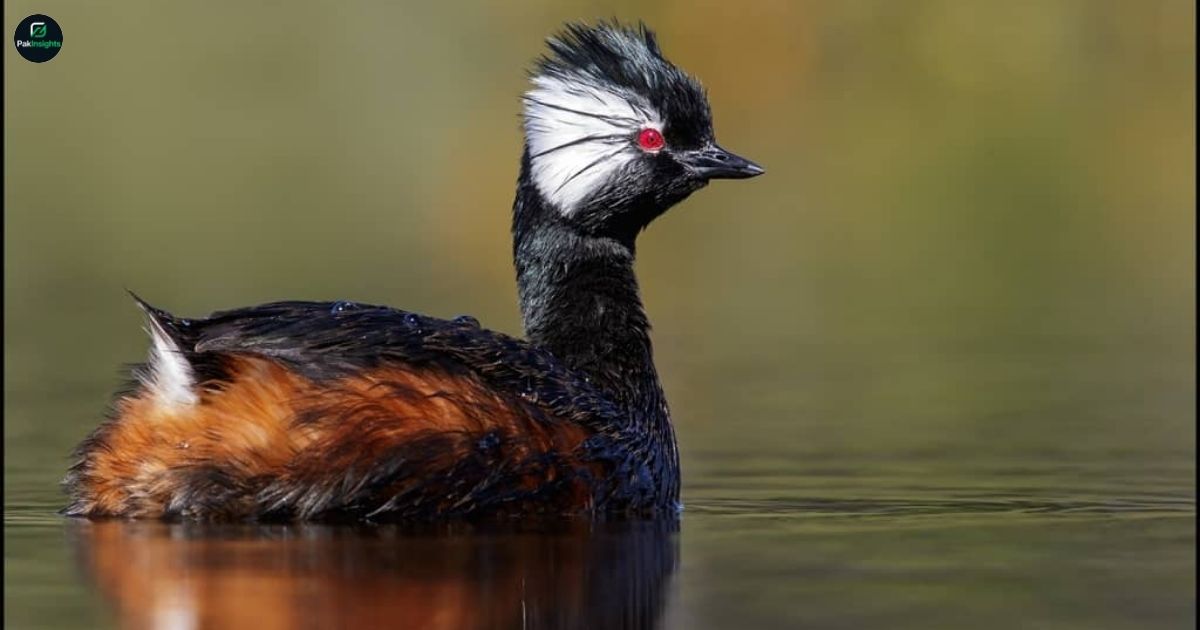
The White-tufted Grebe, also known as Rolland’s grebe or Rollandia rolland, is one of the most elegant South American freshwater birds. Its striking breeding plumage with a black crest, white tufts, and vivid red eye birds make it a favorite among bird watchers. Found mainly in southern and western South America, this species captivates with its graceful swimming, deep diving, and unique nesting behavior. Unlike many waterbirds, the White-tufted Grebe often chooses floating vegetation for its nest, showcasing its close bond with aquatic habitats.
These grebe species vary across their subspecies differences (chilensis, morrisoni, rolland), each showing unique behavioral differences between subspecies. The largest, R. r. rolland, is almost flightless and lives on the Falkland Islands. Meanwhile, R. r. chilensis and R. r. morrisoni thrive on the mainland of Argentina, Peru, Brazil, Chile, Bolivia, Paraguay, and Uruguay. Understanding these differences helps researchers study migration patterns and territoriality, as well as interactions with other birds.
Overview of the White-tufted Grebe
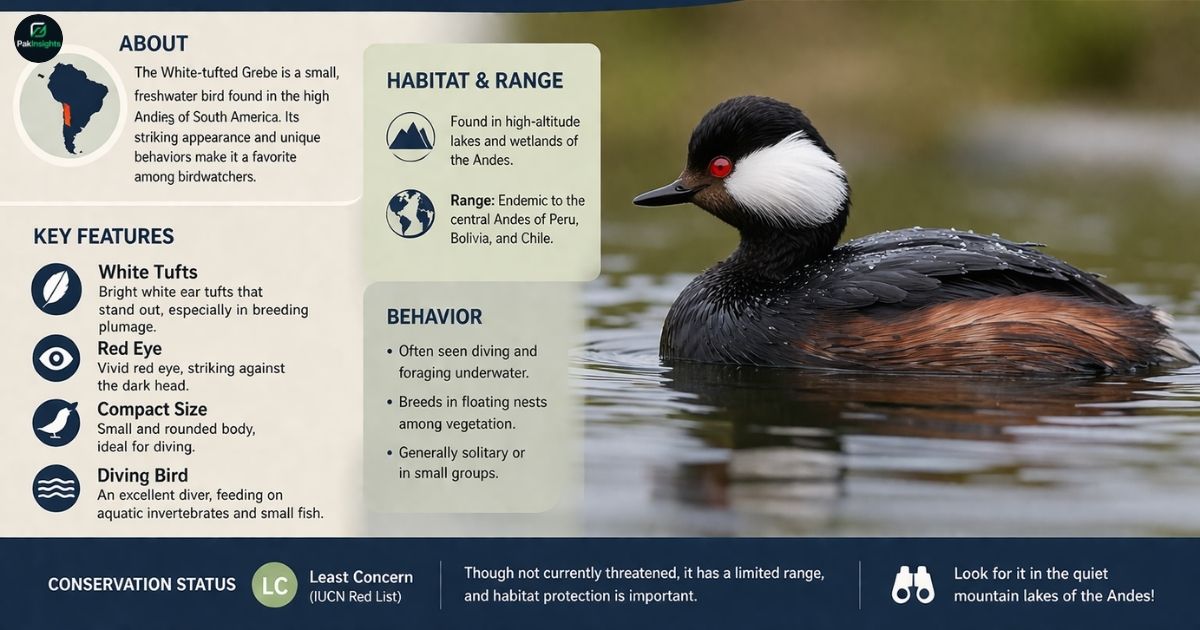
The White-tufted Grebe is a medium-sized waterbird, measuring between 24 and 36 cm. Its appearance and size are remarkable, with adults showing a prominent black crest, white ear tufts, and subtle brown underparts. Juveniles resemble adults in non-breeding plumage but often have brown streaks along the neck. The species is highly adaptable, inhabiting freshwater lakes, ponds, rivers, and occasionally coastal bays. Habitat and distribution extend from lowlands to 4,500 meters above sea level, including South Sandwich Islands, South Georgia, and the Falkland Islands, where the grebes show unique adaptations like reduced flight ability.
Behaviorally, the White-tufted Grebe is a social yet territorial species. Outside the breeding season, it can form small flocks, but during nesting, its territorial behavior becomes evident. The bird dives frequently for food, staying submerged for 20 seconds or more. Observing its interaction with other waterbirds reveals interesting protective strategies, as nests are sometimes built near aggressive gulls to avoid predators. The aquatic habitat is essential for both feeding and reproduction.
Diet, Breeding, and Life Cycle
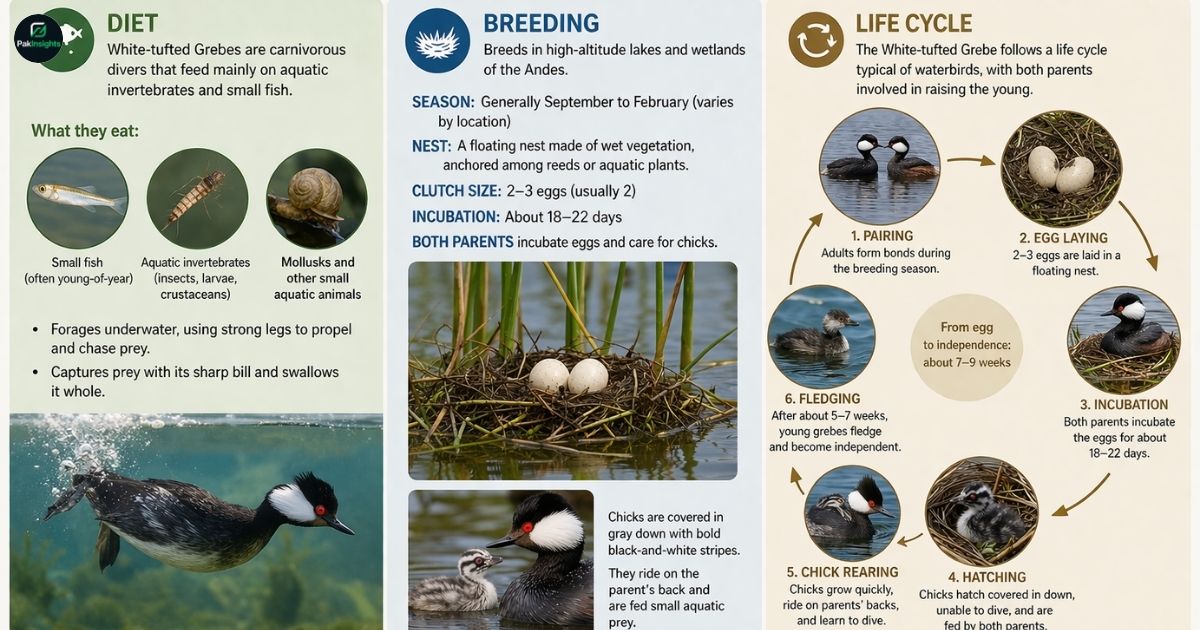
The feeding behavior and diet of the White-tufted Grebe revolve mostly around small fish, arthropods, and occasional aquatic vegetation. It catches prey by diving or submerging only its head while swimming. Prey can measure up to 15 cm, making this migratory grebe a skilled hunter. Seasonal changes in food availability influence its breeding and nesting timing.
During breeding, the nesting and breeding behavior are fascinating. Nests are usually floating platforms made of reeds, grasses, or aquatic vegetation. In the Falkland Islands, birds’ nests may attach directly to land or shore banks. Clutch size varies from one to three eggs but can occasionally reach six, with typical clutch size and egg dimensions around 40 by 28 millimeters. Breeding plumage becomes prominent during mating displays. Observing territoriality shows how pairs defend nesting areas aggressively, particularly in regions with limited suitable nesting sites.
| Subspecies | Region | Nesting Style | Flight Ability | Notable Features |
|---|---|---|---|---|
| R. r. chilensis | Mainland South America | Floating | Strong | Smaller, territorial |
| R. r. morrisoni | Lake Junin, Peru | Floating | Moderate | Solitary nesters |
| R. r. rolland | Falkland Islands | Land/Attached | Almost flightless | Larger, deeper rufous underparts |
Conservation Status and Human Interaction
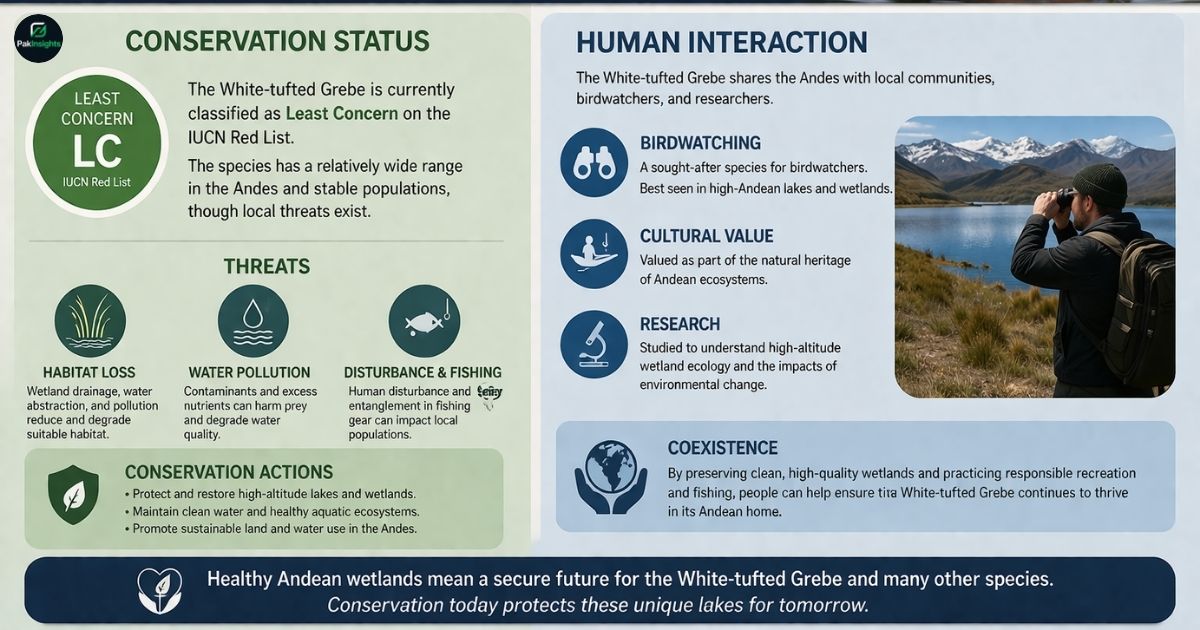
The White-tufted Grebe is listed as Least Concern by the IUCN, showing a stable overall population trend and conservation status. However, some endangered subspecies (Junin grebe) have small populations, making them vulnerable. Human impact, including habitat destruction and pollution, affects these local populations. Protecting aquatic habitats is crucial for their survival.
Conservation efforts include monitoring breeding sites, protecting wetlands, and promoting eco-tourism that benefits both birds and communities. This species’ interaction with other waterbirds also highlights the importance of preserving entire ecosystems. Bird watchers in the USA often study these South American species through migration patterns, helping researchers understand their behavior and territoriality. Educating the public about these elegant grebes ensures continued interest and conservation for future generations.
Frequently Asked Questions
Q1: What is a White-tufted Grebe?
A White-tufted Grebe, also called Rolland’s grebe, is a South American waterbird with a black crest, white ear tufts, and vivid red eyes.
Q2: Where do White-tufted Grebes live?
They live in freshwater lakes, ponds, and rivers across Argentina, Peru, Brazil, Chile, Bolivia, Paraguay, Uruguay, and the Falkland Islands.
Q3: What do White-tufted Grebes eat?
Their aquatic vegetation diet includes small fish, arthropods, and occasionally aquatic plants, caught through diving or head-submerged foraging.
Q4: How do they breed?
White-tufted Grebes build floating nests from reeds and grasses, usually laying 1–3 eggs, though occasionally up to six.
Q5: Are White-tufted Grebes endangered?
Most are Least Concern IUCN, but local populations like the Junin grebe are considered endangered subspecies due to small numbers.