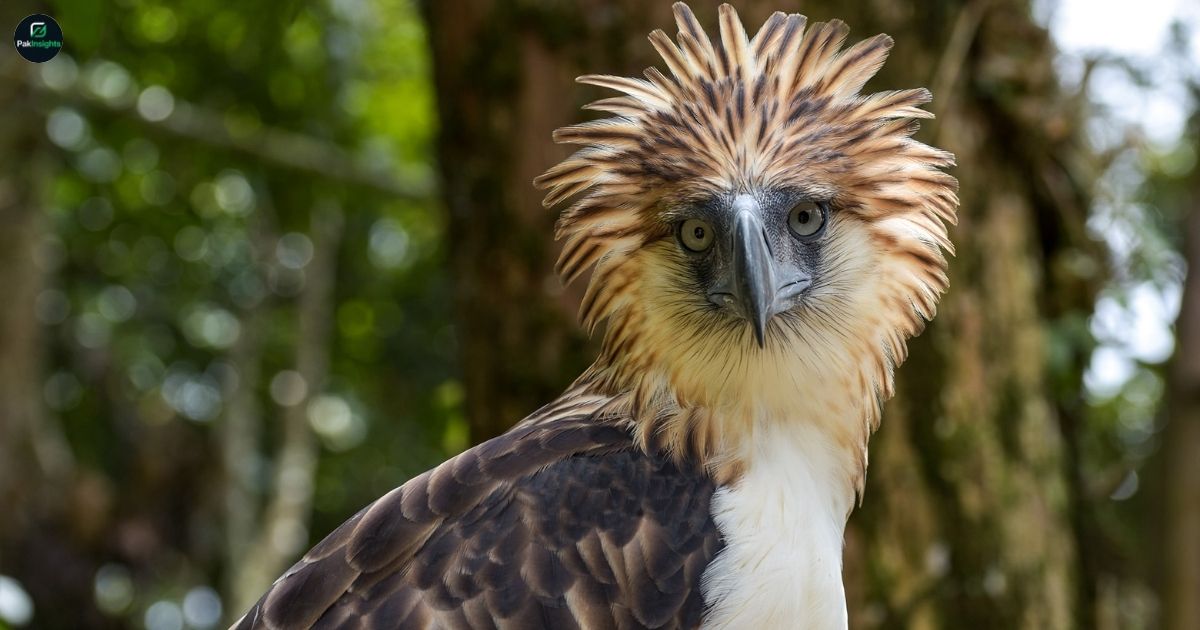
Few birds capture the imagination like the Philippine Eagle, also known as Pithecophaga jefferyi or the monkey-eating eagle. This awe-inspiring predator is endemic to the Philippines and holds the title of the National bird of the Philippines. It is a true symbol of strength and grace, admired by scientists, birdwatchers, and wildlife enthusiasts around the world. Sadly, it is also one of the most critically endangered eagles, with only a few hundred left in the wild.
The Philippine Eagle is not just a bird; it represents the fragility of Philippine forests. Its existence depends on vast, untouched habitats that are vanishing due to deforestation and human activity. For anyone fascinated by wildlife or conservation, learning about this apex predator offers both wonder and a call to action. From its brown and white plumage to its keen hunting skills, the Philippine Eagle showcases nature’s brilliance in every detail.
Origins, Physical Traits, and Unique Adaptations
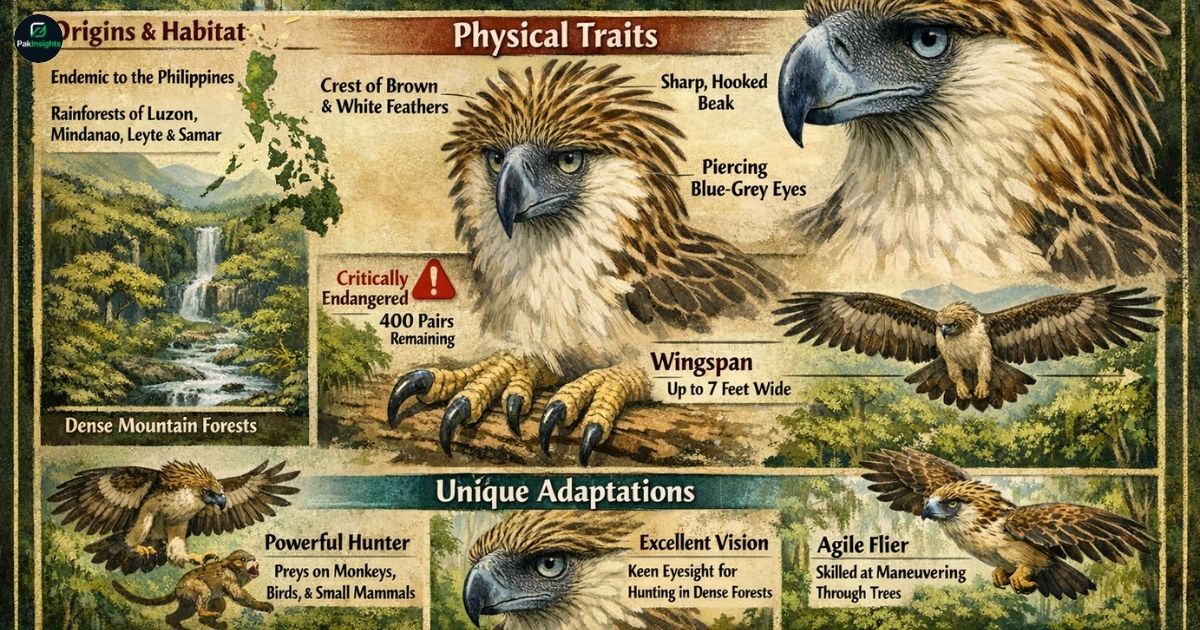
The Philippine Eagle was first documented in 1896 and was initially called the monkey-eating eagle due to early reports of its diet. This magnificent bird belongs to the family Accipitridae and has no recognized subspecies. The name Pithecophaga jefferyi honors Jeffery Whitehead, son of the explorer John Whitehead. Over time, research revealed it feeds on a variety of prey, including flying lemurs, civets, reptiles, and hornbills, making it an opportunistic predator rather than a strict monkey hunter.
Physically, the Philippine Eagle is striking. It has a shaggy crest, large wingspan, powerful beak and talons, and bluish-gray eyes. Males are smaller than females, showing clear sexual dimorphism in size, and some individuals rank among the longest extant eagles in the world. Compared to other large eagles like the Harpy eagle or Steller’s sea eagle, it is longer but slightly lighter, allowing it to maneuver swiftly through dense dipterocarp forests. Its hunting techniques, perch-hunting and still-hunting, demonstrate remarkable patience and intelligence.
Habitat, Range, and Conservation Status
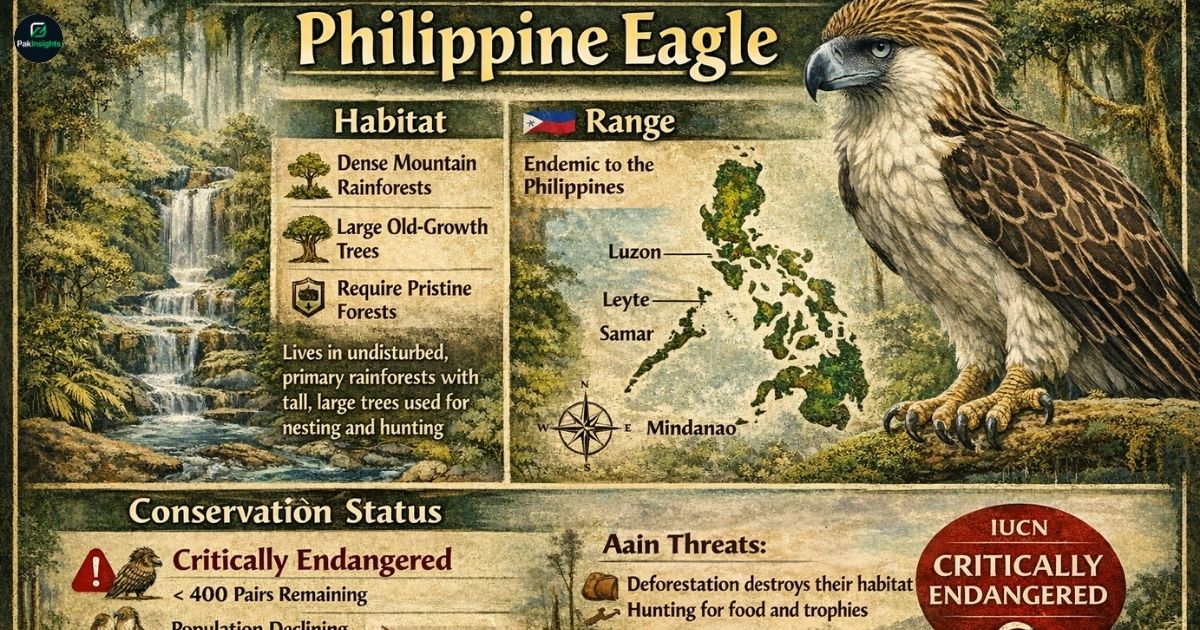
The Philippine Eagle lives on the islands of Luzon, Mindanao, Samar, and Leyte, with the highest population in Mindanao. It thrives in montane forests, steep slopes, and remote valleys, including Mount Apo, Mount Malindang, Mount Kitanglad, and Northern Sierra Madre National Park. These habitats provide the space and prey it needs, from monkeys to tree squirrels. Unfortunately, only a fraction of these forests remain intact, contributing to habitat loss and population decline.
According to the IUCN Red List and CITES Appendix I, the Philippine Eagle is critically endangered. Its population ranges from 180 to 600 individuals in the wild. Deforestation, poaching, and gunshot injuries are the main threats. Even protected areas cannot guarantee safety, highlighting the need for ongoing Philippine eagle conservation. The species is also listed as an EDGE species, emphasizing its evolutionary uniqueness and global importance.
Conservation Efforts and How You Can Help
The Philippine Eagle Foundation has led global efforts to protect this bird through captive breeding, artificial insemination, and reintroduction programs. They have successfully bred over 30 eagles in captivity and released several back into the forests. In 2024, rescued eagles were reintroduced to Leyte, where natural populations had vanished after Typhoon Haiyan. These programs combine science with community education to secure a future for the National bird of the Philippines.
Individuals can also make a difference. Supporting protected areas, spreading awareness, donating to conservation programs, or participating in eco-tourism can help. International collaborations, like the Singapore wildlife diplomacy program, further strengthen global support. Each effort, no matter how small, contributes to saving a bird that symbolizes both the beauty and fragility of Philippine forests. As researchers continue to study juvenile behavior, courtship displays, and breeding cycles of 2 years, every discovery informs better protection strategies for this iconic species.
Table: Key Facts About the Philippine Eagle
| Feature | Details |
|---|---|
| Scientific Name | Pithecophaga jefferyi |
| Common Names | Philippine eagle, monkey-eating eagle |
| Status | Critically endangered eagle |
| Habitat | Dipterocarp forests, montane forests in Luzon, Mindanao, Samar, Leyte |
| Length | 86–112 cm (3–3.6 ft) |
| Wingspan | 184–220 cm (6–7 ft) |
| Diet | Apex predator: monkeys, colugos, flying lemurs, civets, reptiles, and hornbills |
| Lifespan | 30–60 years (wild), up to 46 years (captivity) |
| Nesting | Monogamous species, nesting habits, courtship display, egg incubation (58–68 days) |
| Conservation Programs | Apex predator; monkeys, colugos, flying lemurs, civets, reptiles, and hornbills |
Frequently Asked Questions
Q1: How big is a Philippine Eagle?
The Philippine Eagle measures 86–112 cm in length, with a large wingspan of 184–220 cm, making it one of the longest extant eagles.
Q2: What does the Philippine Eagle eat?
It is an apex predator, feeding on monkeys, flying lemurs, civets, reptiles, and hornbills, using perch-hunting and still-hunting techniques.
Q3: Where can the Philippine Eagle be found?
This bird is endemic to the Philippines, living on Luzon, Mindanao, Samar, and Leyte in dipterocarp and montane forests.
Q4: Why is the Philippine Eagle critically endangered?
Deforestation, habitat loss, poaching, and gunshot injuries have drastically reduced its numbers to only 180–600 individuals in the wild.
Q5: How long do Philippine Eagles live?
Wild eagles live 30–60 years, while some in captivity have survived up to 46 years under proper care.