
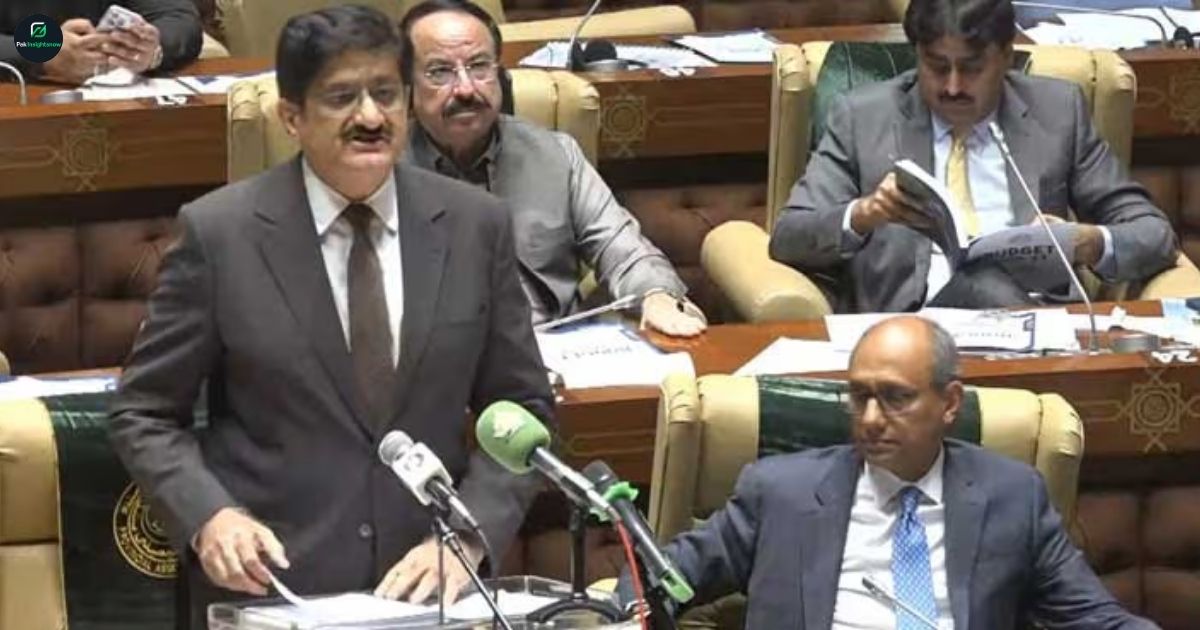
The Sindh Budget 2026-27 Karachi projects were officially unveiled on Wednesday as the provincial government announced a massive development push focused on improving infrastructure, transport, and public services in Karachi. The budget highlights 816 development schemes for the city, making it one of the largest urban investment plans in recent years.
The budget was presented by Murad Ali Shah in the provincial assembly. It outlines a total outlay of Rs 3.652 trillion, with a strong emphasis on development spending, social protection, and infrastructure upgrades across Sindh.
Massive development push for Karachi
Karachi remains the central focus of the new budget, with 816 development projects estimated at Rs 644 billion. The government has allocated funds for roads, flyovers, drainage systems, water supply, and public transport improvements.
Officials say the plan aims to ease Karachi’s long-standing infrastructure challenges, including traffic congestion, water shortages, and urban flooding. The government is running several mega projects and has added new schemes for the upcoming fiscal year.
Key transport projects include flyovers, underpasses, and interchanges aimed at improving traffic flow across major corridors. These developments reduce travel time and improve connectivity in high-density areas.
Focus on transport, water, and drainage
A large portion of the Sindh Budget 2026-27 Karachi projects is dedicated to transport infrastructure. The government allocates billions for the Red Line and Yellow Line BRT projects to modernize the city’s public transport system.
Water and drainage systems also receive significant attention. The government allocates funds to expand the K-IV water supply project, rehabilitate trunk mains, and upgrade pumping stations across different districts.
To reduce flood risks, the government has launched stormwater drainage upgrades and is restoring key city nullahs.
Salary increase and social protection
The budget also includes a 7% increase in salaries and pensions for government employees and retirees, effective from July 1. The increase has been merged with existing allowances to provide consolidated relief.
The government has increased the minimum wage from Rs 40,000 to Rs 43,000 per month to support low-income workers amid rising inflation.
A Rs 13.2 billion social protection package has also been introduced. It includes programs for farmers, widows, orphans, and women workers, reflecting the government’s focus on vulnerable communities.
Mega projects and long-term vision
Beyond basic infrastructure, the budget introduces several long-term development ideas. The government uses PPP projects to transform Sindh into a regional hub for trade, finance, technology, and renewable energy.
Plans include coastal and industrial zones, a finance center in Karachi, and renewable-energy-powered data infrastructure.
The government has also announced a large-scale solar initiative under which 275,000 households will receive free solar home systems. This is part of a broader shift toward cleaner and cheaper energy solutions.
The government has included agricultural reforms and waste management programs to boost productivity and sustainability.
Conclusion
The Sindh Budget 2026-27 reflects a strong focus on urban development, particularly for Karachi. With 816 projects planned, the government aims to improve infrastructure, ease traffic pressure, and strengthen essential services. However, the success of these ambitious plans will depend on timely execution and efficient management.