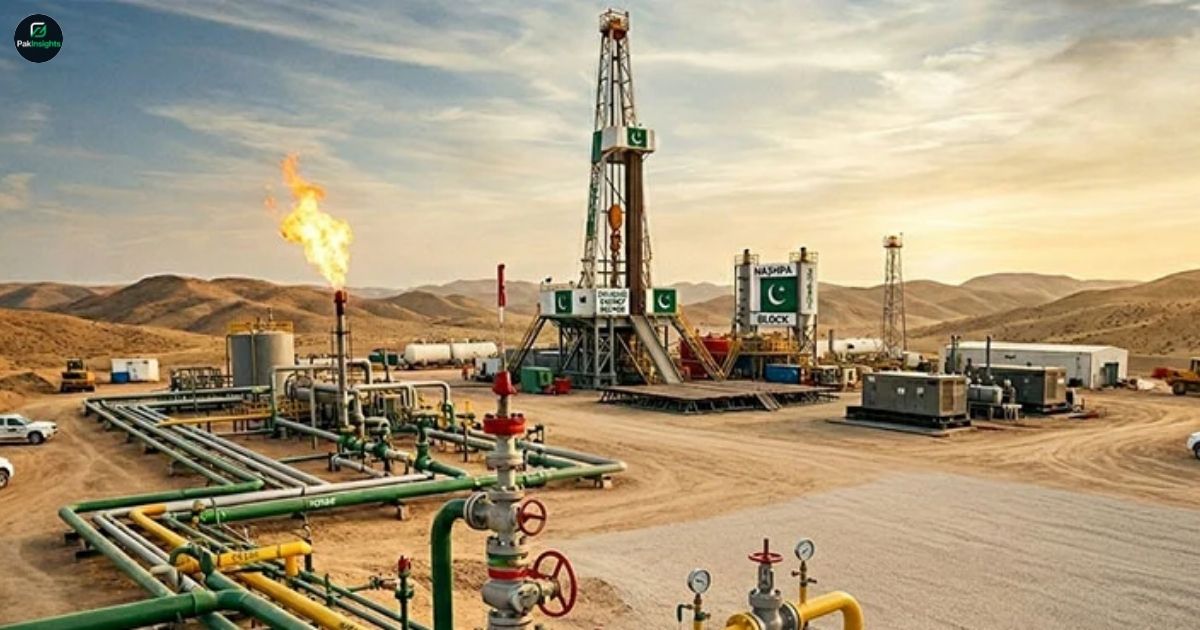
Pakistan has strengthened its domestic energy supply after a major oil and gas discovery. Pakistan added fresh production from the Baragzai X-1 well in the Nashpa Block. Officials say the development marks another step toward reducing reliance on imported fuel and improving long-term energy security.
Federal Petroleum Minister Ali Pervaiz Malik inaugurated the commercial production from the newly active well, calling it an important milestone for the country’s energy sector. The production has now been officially integrated into the national energy system.
The discovery comes at a time when Pakistan continues to face pressure from rising energy demand, import costs, and foreign exchange challenges. Authorities believe new local production can help ease some of these constraints over time.
New production details and output capacity
According to official data, the Baragzai X-1 well is currently producing around 15,000 barrels of crude oil per day. It is also supplying nearly 45 million standard cubic feet of gas daily.
Energy officials expect output to increase in the coming phase. Projections suggest production could rise to 25,000 barrels of oil per day and 60 million standard cubic feet of gas per day as operations stabilize and further development continues.
The government estimates that the project could save around $329 million annually in foreign exchange. This saving comes from reduced dependence on imported oil and gas shipments.
Officials say this type of local production is critical for Pakistan’s energy mix. It helps stabilize supply while reducing pressure on external accounts.
Impact on energy security and economy
Minister Ali Pervaiz Malik said the development will play a key role in strengthening Pakistan’s energy security. He emphasized that increasing domestic production remains a top priority for the government.
Energy experts say local discoveries like this can support industrial growth and reduce vulnerability to global oil price fluctuations. Pakistan imports a large portion of its energy needs, making it sensitive to international market changes.
With new wells coming online, authorities hope to gradually balance the energy mix. This includes increasing domestic oil and gas production while improving efficiency in existing fields.
However, experts also caution that long-term relief will depend on sustained exploration activity, investment in infrastructure, and stable policy support for the energy sector.
Continued exploration in Pakistan’s energy sector
The Baragzai X-1 development is part of a wider wave of exploration activity across Pakistan’s oil and gas sector. Several companies have recently reported discoveries in different regions, reflecting renewed interest in domestic resources.
Earlier, Mari Energies Limited also announced a gas and condensate discovery at its Shams-1 exploratory well in Ghotki district. That well produced nearly 48 million standard cubic feet of gas per day during testing, along with condensate output.
Officials say such discoveries highlight the potential of Pakistan’s sedimentary basins, which continue to attract exploration investment.
Energy authorities believe continued drilling and modern technology can unlock additional reserves in both onshore and offshore areas.
What it means for consumers
While immediate changes in fuel prices are not guaranteed, increased local production can help reduce import pressure over time. This may contribute to greater price stability in the future.
Consumers could benefit indirectly if savings from reduced imports help stabilize the economy and strengthen the rupee.
For now, the government has positioned domestic energy expansion as a key pillar of its broader economic strategy.
The Baragzai X-1 production start adds momentum to this approach, signaling continued focus on self-reliance in energy.