Have you ever wondered why some animals live far longer than humans? Certain turtles, whales, and sharks can survive for decades or even centuries. Scientists have been fascinated by these species’ lifespan differences, searching for clues about animal longevity. Recent discoveries show that the secret isn’t just in their genes but also in how their genes are edited and regulated. This article explores the biology, environment, and record-holding species that live extremely long lives, and what humans can learn from them. By understanding lifespan regulation, researchers aim to unlock secrets of healthy aging for both humans and animals.
From alternative splicing to environmental influences, these long-lived creatures reveal the hidden patterns behind longevity. The maximum lifespan of a species isn’t random. It reflects a delicate interplay of genetics, cellular resilience, and adaptation. Studies from the University of California, Riverside, and the University of Southern California show that the way animals process RNA, especially RNA editing and mRNA variants, directly affects how long they can live. Even the brain, with its complex neural tissue, plays a crucial role in regulating lifespan.
The Biology Behind Longevity
At the heart of why some species live extremely long lives is their biology. A key discovery in recent longevity research is alternative splicing, a process where one gene can produce multiple proteins. This means animals don’t need extra genes to live longer. Sika Zheng and her team found that age-linked splicing events in neural tissue affect neural maintenance and overall cellular resilience. In simpler terms, the way animals’ RNA is edited can determine how well their cells handle stress and damage, which influences maximum lifespan.
Another factor is gene expression and lifespan. Animals with longer lives often have specialized lifespan-related proteins that protect their cells. These proteins are regulated by RNA-binding proteins and transcription-independent mechanisms. Studies show that the brain, in particular, undergoes brain-specific splicing, which strengthens neural adaptability. This complex system allows long-lived species to resist diseases, including neurodegenerative disease prevention, and maintain healthy aging over decades.
Environmental and Lifestyle Factors
While biology lays the foundation, environment and lifestyle shape how long species live. Diet is one of the most significant factors. For example, animals with calorie-controlled diets or nutrient-rich feeding patterns often live longer. Habitats also play a role. Species that face fewer predators or live in stable ecosystems have extended lifespans. Social behaviors, like cooperative living or strong family bonds, help animals survive stress and increase their longevity.
Humans can learn from these patterns. In captivity, certain species live longer due to controlled environments, proper nutrition, and stress-free conditions. Research on species adaptation mechanisms highlights that long-lived animals have evolved molecular programs for longevity to cope with environmental challenges. The combination of diet, environment, and lifestyle, along with biological factors like tissue-specific gene regulation, makes a dramatic difference in maximum lifespan.
| Factor | Effect on Longevity | Examples |
|---|---|---|
| Diet & Nutrition | Increases lifespan, supports cellular resilience | Tortoises, primates in zoos |
| Habitat Stability | Reduces stress, lowers mortality | Bowhead whales in Arctic waters |
| Social Behavior | Promotes survival and adaptation | African elephants, wolves |
| Environmental Safety | Fewer predators and hazards | Giant tortoises on islands |
Record-Holding Long-Lived Species
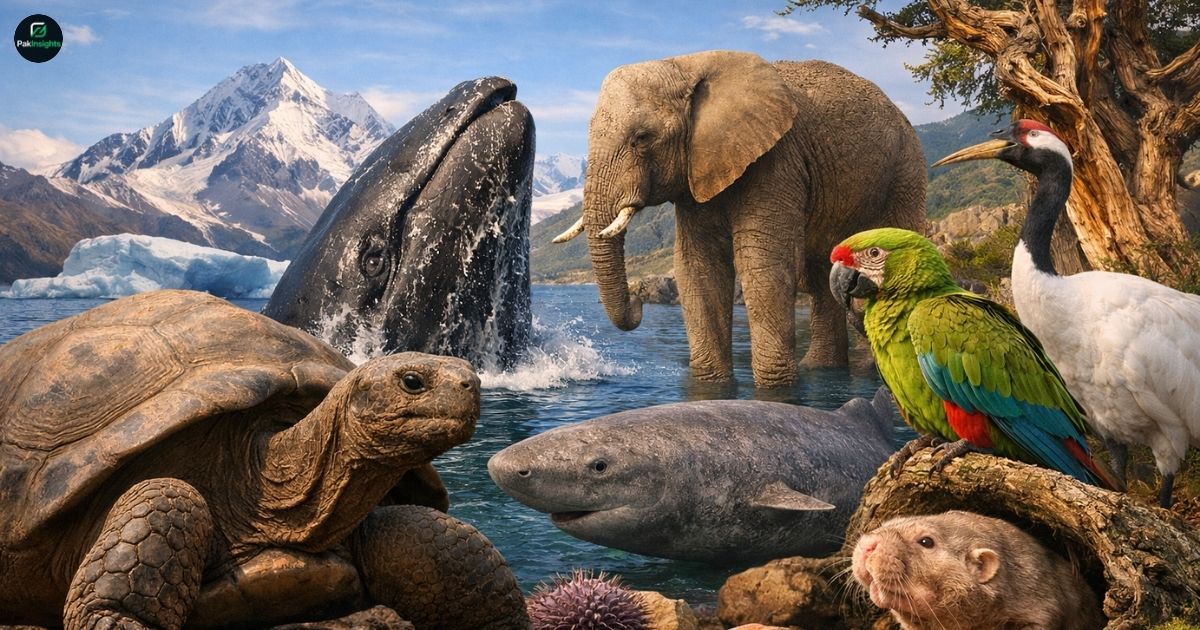
Some species hold astonishing lifespan records. Giant tortoises, like the Aldabra and Galápagos, can live over 150 years. The Greenland shark is a remarkable marine species, often reaching over 400 years old. Bowhead whales, another long-lived marine species, can survive more than 200 years. These species show unique adaptations that strengthen cellular resilience, protect DNA, and improve stress response in cells.
Birds, rodents, and even certain fish demonstrate specialized longevity traits. They exhibit lifespan-linked genetic patterns and evolved mechanisms like enhanced mRNA processing and genetic “editing” to resist aging. Scientists, including Liang Chen, study these animals to understand how brain-specific splicing and neural tissue complexity affect lifespan. These insights could help humans develop interventions for healthy aging and potentially extend our maximum lifespan.
| Species | Lifespan | Key Longevity Factor |
|---|---|---|
| Aldabra Tortoise | 150+ years | Slow metabolism, DNA protection |
| Bowhead Whale | 200+ years | Cellular resilience, RNA editing |
| Greenland Shark | 400+ years | Stress resistance, lifespan-linked proteins |
| Macaw Parrots | 80+ years | Brain-specific splicing, neural maintenance |
Studying why some species live extremely long lives gives us more than fascinating facts. It uncovers hidden layers of RNA biology, shows the impact of neural adaptability, and inspires evolutionary lifespan optimization research. The interplay of alternative splicing, environmental factors, and species adaptation mechanisms reveals the blueprint of longevity. By learning from these animals, humans may one day apply these insights to improve healthy aging, disease resistance, and overall lifespan.
Frequently Asked Questions
Q1: Why do some species live much longer than others?
Some species live longer due to a combination of genetics, alternative splicing, RNA editing, and environmental factors that enhance cellular resilience and healthy aging.
Q2: Which species are the longest-living in the world?
Giant tortoises, Greenland sharks, and Bowhead whales are among the longest-lived, often surpassing 150–400 years, thanks to lifespan-linked genetic patterns and neural maintenance.
Q3: How does the brain affect animal longevity?
The brain plays a key role through brain-specific splicing and neural adaptability, helping animals maintain stress response in cells and resist aging-related diseases.
Q4: Can studying long-lived species help humans?
Yes, research on molecular programs for longevity and species adaptation mechanisms offers insights for healthy aging and potential maximum lifespan improvement in humans.
Q5: What is alternative splicing, and why is it important for lifespan?
Alternative splicing allows one gene to produce multiple proteins, increasing biological diversity through splicing and enabling animals to regulate lifespan-related proteins effectively.