
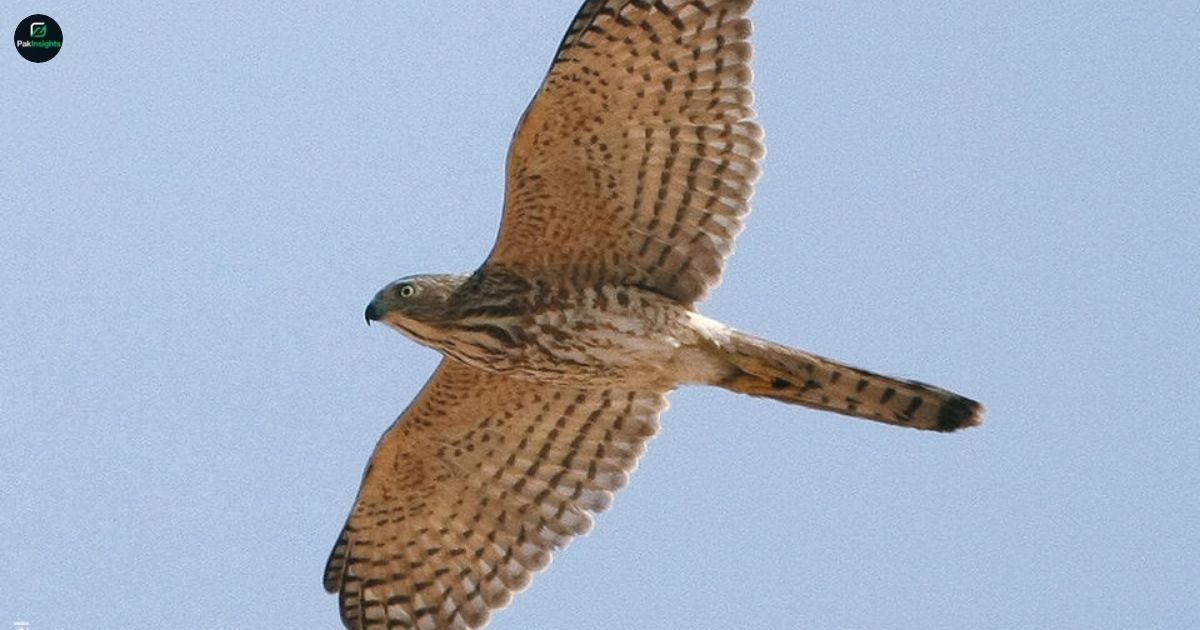
The Shikra bird is a fascinating small bird of prey that belongs to the Accipitridae family. Known scientifically as Tachyspiza badia, or sometimes Accipiter badius, this bird is widespread in Asia and Africa. Often called the little banded goshawk, it is admired for its sharp eyesight, agile flight, and hunting skills. Many bird enthusiasts in the USA are intrigued by this Asian hawk species because of its unique hunting behavior and adaptability. Whether seen soaring over forests or urban landscapes, the Shikra bird is a remarkable example of a small raptor species thriving in diverse environments.
Though small in size, this hawk species in Asia and Africa demonstrates immense skill in capturing prey. With its sharp talons and fast flap-and-glide flight, the Shikra can hunt rodents, small birds, and lizards efficiently. Its presence in the wild has been recorded in various Indian birds of prey, forest and urban raptors, making it an important part of the ecosystem. The Shikra bird in Pakistan and India is particularly noted for its cultural significance in falconry and local traditions.
Appearance, Identification, and Subspecies
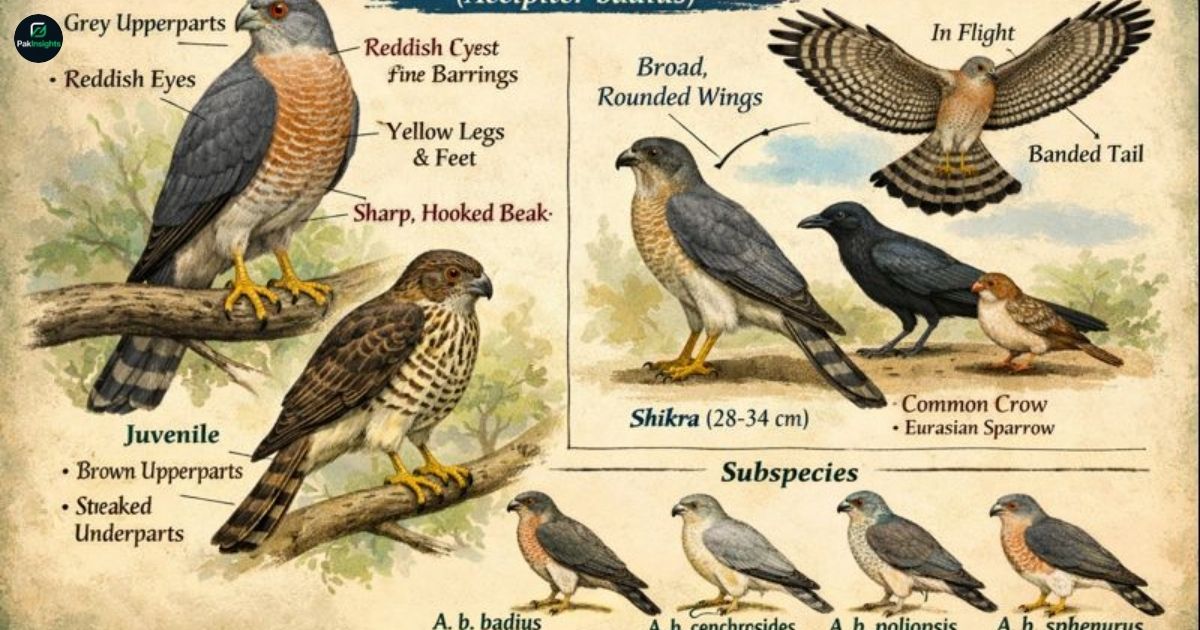
The Shikra bird is a small raptor bird, measuring about 10–12 inches in length. It has grey upperparts and rufous-barred underparts. Its short, rounded wings and long, narrow tail give it agility during flight. Male Shikras have a red iris, while females show a yellowish-orange iris. Juveniles have distinct juvenile plumage, often darker with streaks on the chest and wings. The Shikra bird is sometimes confused with the Eurasian sparrowhawk, but subtle differences like tail bands and wing markings help in identification. Observing its flap-and-glide flight is one of the easiest ways to spot this small bird of prey in the wild.
There are six recognized Shikra subspecies, each adapted to different regions. T. b. sphenura is found from Senegal to Tanzania, while T. b. polyzonoides inhabits southern Africa. The Indian population, T. b. dussumieri, lives in plains and lower hills, and T. b. cenchroides is found in Central Asia. T. b. poliopsis occurs in north India and Southeast Asia, and T. b. badia resides in Sri Lanka and southwest India. This variation allows the Asian hawk species and the African hawk species to thrive in diverse climates and habitats.
Habitat, Distribution, and Behavior
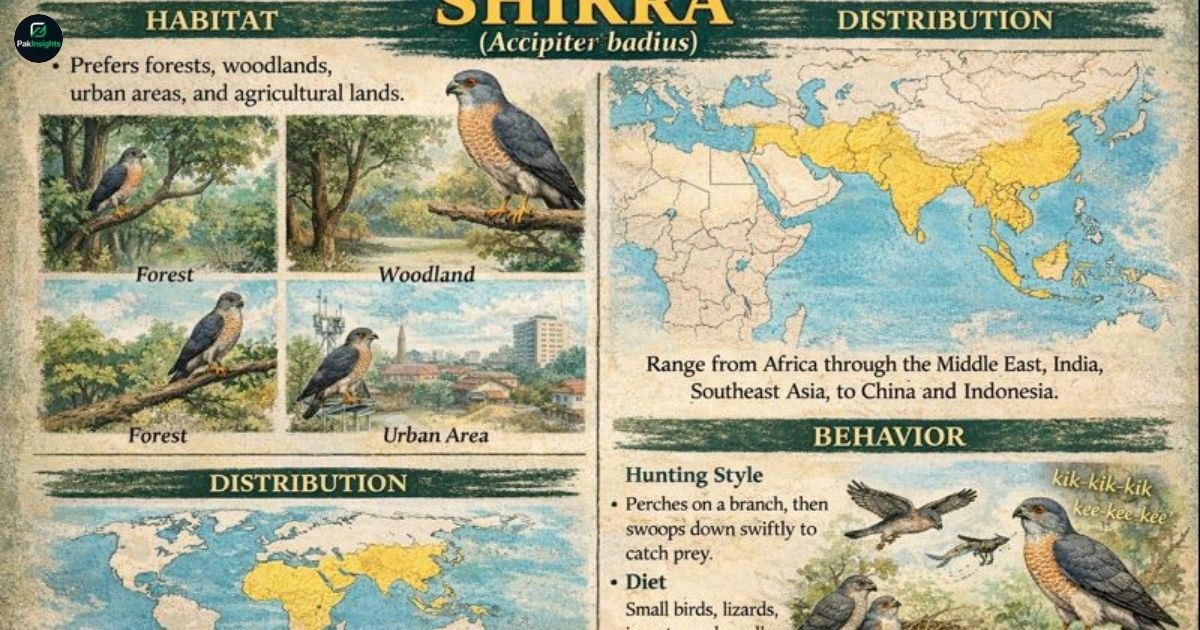
The Shikra bird is versatile and inhabits forests, farmland, and urban habitats across Asia and Africa. Its Asia and Africa distribution covers regions from India and Pakistan to Sri Lanka, and parts of West and Southern Africa. As a resident raptor bird, some populations stay in the same area year-round, while African migratory hawks move seasonally to follow prey. In the Indian subcontinent, birds and Sri Lankan bird species, Shikra, are commonly seen perched on trees, hunting from rooftops, or gliding over fields.
The Shikra diet and hunting style are remarkable. These rodent-eating birds and small bird predators rely on stealth, speed, and sharp talons to capture prey. They also hunt lizards and reptile prey, insects, and occasionally even small bats. Shikras often descend to catch termites emerging from the ground. Their alarm calls among birds alert prey and other raptors, while drongo call mimicry allows them to trick smaller birds. This adaptability makes them one of the most skilled small raptor species in their range.
Breeding, Conservation, and Cultural Significance
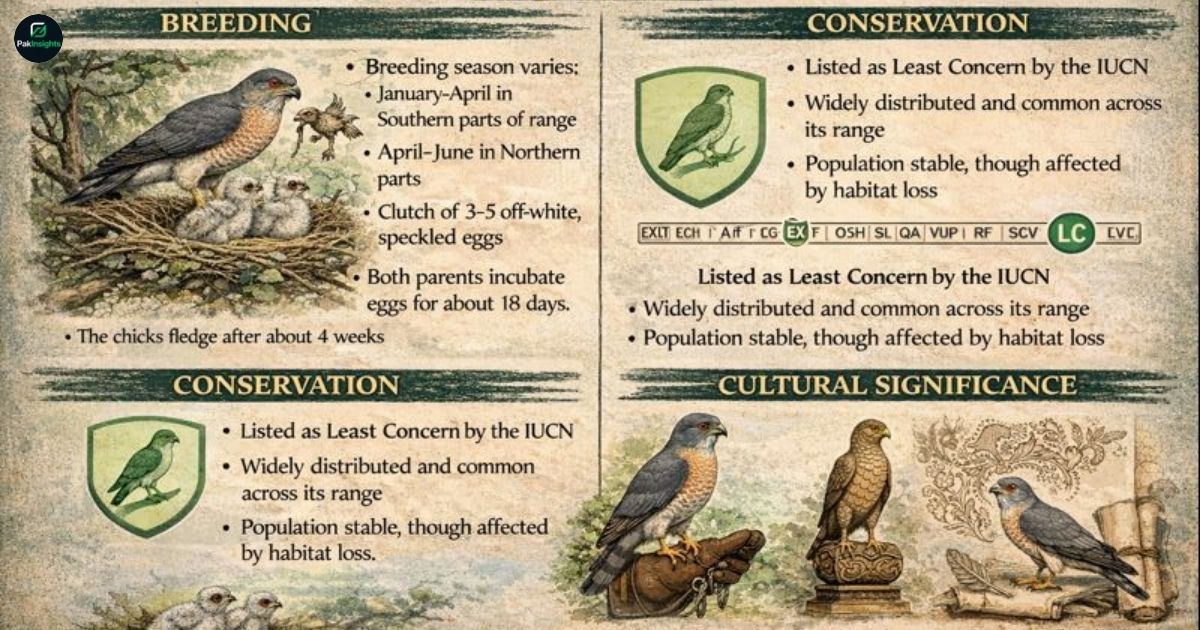
The Shikra breeding season occurs in India during summer, usually from March to June. The nesting behavior of hawks involves building platform nests lined with grass, sometimes even using metal wires in urban areas. The clutch size of Shikra is typically three to four eggs, with an incubation period of 18–21 days. Both males and females participate in nest building and feeding the chicks. These summer breeding birds in India are resilient and often replace eggs if the first clutch is lost, ensuring the survival of their young.
The Shikra conservation status is Least Concern according to the IUCN Red List of birds, but habitat loss can pose local threats. In the cultural and linguistic context, Shikras have been popular in falconry in India and Pakistan, prized for their hunting skills. The Urdu word Shikra literally means hunter, reflecting its predatory nature. The bird also appears in poetry, including the Punjabi poetry reference in Shiv Kumar Batalvi’s poem, symbolizing agility, focus, and freedom. Throughout bird symbolism in literature, the Shikra bird represents sharpness, strategy, and survival.
Comparison Table: Shikra vs Similar Hawks
| Feature | Shikra (Tachyspiza badia) | Eurasian Sparrowhawk | Little Banded Goshawk |
|---|---|---|---|
| Size | 10–12 in | 11–14 in | 12–14 in |
| Wing Shape | Short rounded wings | Rounded wings | Rounded wings |
| Tail | Long narrow | Medium | Medium |
| Eye Color | Red (male), Yellow-orange (female) | Yellow | Yellow |
| Habitat | Forest, urban, farmland | Woodland | Forest |
| Distribution | Asia and Africa | Europe & Asia | Africa |
The Shikra bird is a small but formidable predator among birds of prey in Pakistan and India and across its range. Its adaptability, hunting skills, and cultural importance make it an ideal subject for bird watchers and researchers alike. Whether you observe a forest or urban raptor, a Shikra always leaves an impression with its speed, agility, and striking appearance. Understanding its habitat, behavior, and breeding provides deeper insights into the Asian hawk species and the complex ecosystems they support.
Frequently Asked Questions
Q1: What is a Shikra bird?
The Shikra bird is a small bird of prey in the Accipitridae family, known for its sharp eyesight and fast, agile flight.
Q2: Where does the Shikra live?
Shikras inhabit forests, farmland, and urban habitats across Asia and Africa, including India, Pakistan, and Sri Lanka.
Q3: What does a Shikra eat?
They are rodent-eating birds and small bird predators, also hunting lizards, insects, and occasionally bats.
Q4: How can I identify a Shikra?
Look for short, rounded wings, a long, narrow tail, red iris in males, and rufous-barred underparts.
Q5: When is the Shikra breeding season?
The Shikra breeding season in India occurs in summer, from March to June, with 3–4 eggs per clutch.
Meta Description
Discover the Shikra, a small bird of prey with sharp hunting skills, unique flight, and cultural significance.