
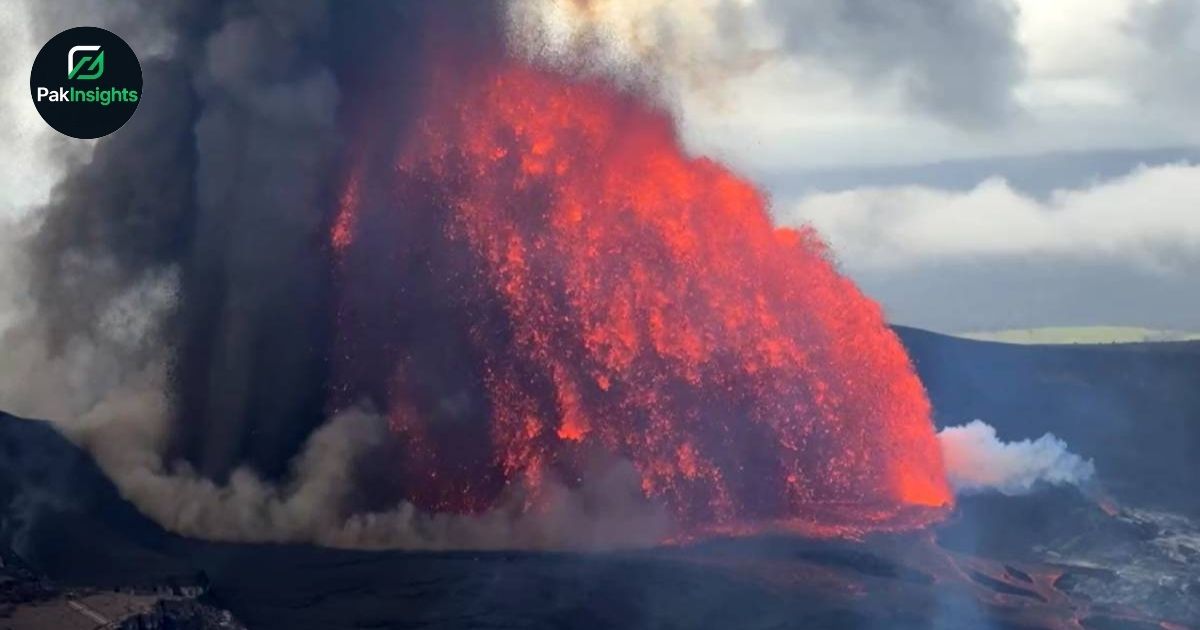
The Big Island of Hawaii witnessed a rare and dramatic natural event as the Kīlauea volcano eruption, triple lava fountains, and an ash cloud over Puna captivated scientists and residents alike. Episode 38 of the ongoing episodic eruption inside Halemaʻumaʻu Crater produced three simultaneous lava fountains, reaching heights of up to 1,200 feet. The unprecedented event marked one of the most visually striking eruptions in recent years, sending a massive volcanic ash cloud across Puna and affecting air quality in nearby communities.
Rare Triple Lava Fountain and Lava Flows
Lava effusion rates soared, and as a result, the eruption ejected more than 16 million cubic yards of lava. Molten spatter and incandescent lava covered the crater floor, while pumice, tephra, and Pele’s hair drifted through the high plume. Molten spatter and incandescent lava covered the crater floor, while pumice, tephra, and Pele’s hair drifted through the high plume. Scientists recorded rapid summit deflation and inflation, along with increased seismic tremor and precise tiltmeter readings, indicating the volcano’s high-effusion activity. The lava flows, moving through Kaluapele, are expected to gradually cool and solidify over the coming days.
Ash Cloud, Volcanic Hazards, and Community Impact
The eruption produced a towering volcanic ash cloud, reaching over 20,000 feet above sea level. Ash fallout affected Pāhala, Puna, and surrounding areas, prompting evacuation alerts and concerns over air quality. Authorities continue to advise caution near the crater and along Chain of Craters Road.
Monitoring and Scientific Significance
The Hawaiian Volcano Observatory continues to track Kīlauea closely. Episode 38 offers scientists invaluable data on eruption patterns, lava dynamics, and the formation of triple lava fountains. Understanding episodic eruptions, plume behavior, and lava effusion rates helps improve eruption monitoring, predict hazards, and safeguard local communities. This event highlights the importance of combining field observation, satellite imagery, and live video capture for accurate scientific analysis.
Visit the USGS Hawaiian Volcano Observatory for more details.
Meta Description
Kīlauea volcano eruption, triple lava fountains, and ash cloud over Puna send lava flows, tephra, and volcanic gas across the Big Island of Hawaii.