
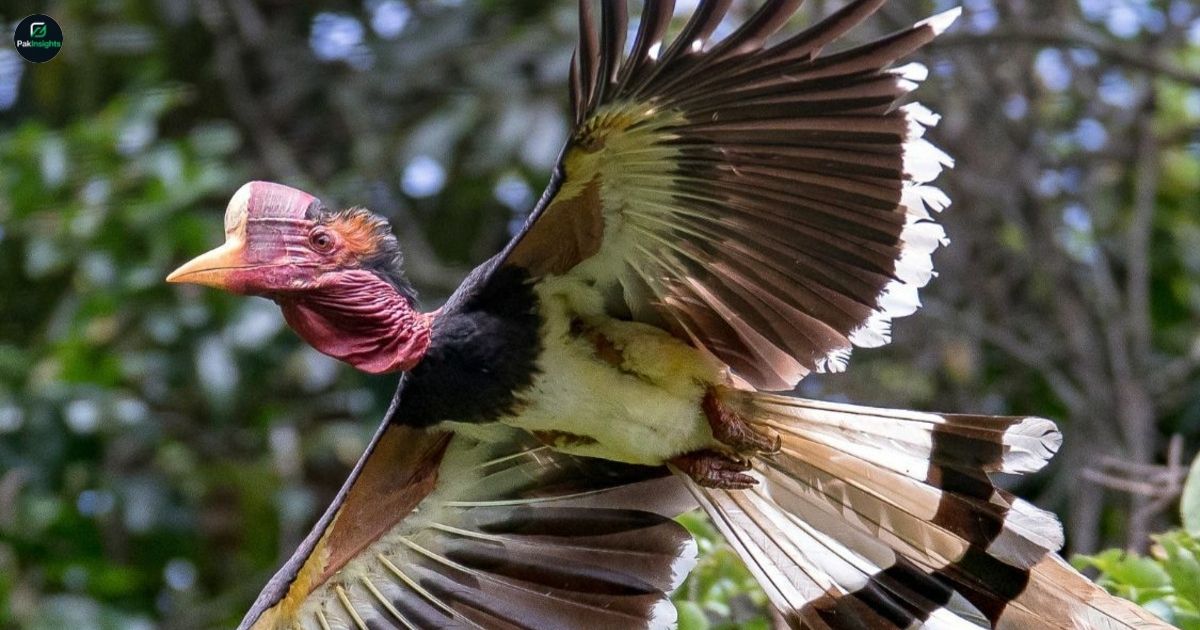
The Helmeted hornbill, scientifically known as Rhinoplax vigil, is one of the most fascinating hornbill species in the world. Found mainly in the Malay Peninsula, Sumatra, Borneo, Thailand, and Myanmar, this bird is a critically endangered bird that has captured the attention of conservationists globally. Its unique casque (helmet-like structure), solid and striking, makes it stand apart from other hornbills. Unlike most birds, male Helmeted hornbills use their nearly solid casque to engage in fierce head-to-head combat. With a body length reaching up to 170 cm, including the tail, and a body weight (3 kg male, 2.7 kg female), it is among the largest Asian hornbill species and a true giant of the Bucerotidae family.
The Helmeted hornbill has a dramatic appearance. Its plumage (blackish with white belly and tail) contrasts with the bare throat patch (blue, green, red) that signals the bird’s age and gender. The tail feathers (long central feathers) make the bird appear even larger. Its skull and bill structure are unique; the solid casque constitutes almost 10% of its weight. The Helmeted hornbill projects its vocalizations, hoots, and axe-like calls up to 2–3 kilometers, using them to warn rivals and attract mates. In the wild, this bird is territorial, engaging in spectacular aerial jousting that displays territorial behavior and dominance.
Overview and Unique Features of the Helmeted Hornbill
The Helmeted hornbill is not just physically impressive but behaviorally unique. Its monogamous breeding system and specialized nesting in tree cavities ensure the young are protected. The female seals herself and her chick inside the tree for the first five months of life, relying entirely on the male for food. During this time, the male brings fruits, mainly feeding on strangler figs, which provide high-energy nutrition. People value the casque for its hornbill ivory in cultural practices, which has unfortunately driven poachers to target the species.
Other behavior and habits of this bird include their loud vocalizations/hoots / axe-like call and highly territorial actions. Head-to-head combat in flight demonstrates strength and skill, while long periods of observation show a careful social hierarchy among males. Compared to related hornbills like the Great hornbill or Rhinoceros hornbill, the Helmeted hornbill is exceptional for its solid casque and rare combat behavior, making it one of the most fascinating hornbill species globally.
Habitat, Distribution, and Ecology
The Helmeted hornbill thrives in dense rainforest ecosystems. Its range includes the Malay Peninsula, Sumatra, Borneo, Thailand, and Myanmar, where large trees provide both food and nesting sites. These forests are rich in strangler figs, a critical food source, and deep tree cavities that allow safe nesting in tree cavities. The bird plays a vital role in the ecosystem, spreading seeds and maintaining forest diversity. Losing the Helmeted hornbill would disrupt natural seed dispersal and ecological balance.
The Helmeted hornbill thrives in the rainforest, perfectly adapted to its ecological challenges. It avoids human disturbance and is highly sensitive to habitat loss. Researchers have observed Helmeted hornbills fiercely defending their territories through aerial jousting and loud calls. These birds rely on large contiguous forests, which makes the endangered birds of Borneo highly vulnerable to deforestation. The hornbill uses its casque in courtship and social dominance displays, giving the structure important ecological significance.
Threats, Conservation Efforts, and Future Outlook
The Helmeted hornbill faces severe threats due to poaching / illegal wildlife trade, and habitat loss. Hunters illegally target Helmeted hornbills because their solid casque is highly valued as hornbill ivory. TRAFFIC reports show that authorities seized thousands of Helmeted hornbill casques in recent years, yet the population keeps declining. In Thailand, there are fewer than 100 birds in Thailand, highlighting the urgent conservation crisis. Threats from hunting and deforestation make recovery extremely challenging.
Conservation efforts focus on legal protection and habitat preservation. CITES Appendix I and the IUCN Red List list the Helmeted hornbill as critically endangered, providing it with international protection. Protected areas and awareness campaigns aim to reduce hornbill poaching in Southeast Asia. Local communities and indigenous groups, such as the Punan Bah and Orang Ulu, have also contributed to preservation, respecting the cultural and historical significance of the bird. Preserving the Helmeted hornbill requires global collaboration to save one of the most extraordinary creatures in the Bucerotidae family.
| Feature | Details |
|---|---|
| Scientific Name | Rhinoplax vigil |
| Family | Bucerotidae |
| Length | 110–170 cm (including tail) |
| Weight | 3 kg male, 2.7 kg female |
| Habitat | Rainforests of Southeast Asia |
| Diet | Strangler figs, occasional small animals |
| Conservation Status | Critically Endangered (IUCN), CITES Appendix I |
Frequently Asked Questions
Q1: What is a Helmeted Hornbill?
The Helmeted hornbill (Rhinoplax vigil) is a giant, critically endangered hornbill species found in Southeast Asia, known for its solid casque (helmet-like structure).
Q2: Where do Helmeted Hornbills live?
They live in rainforest ecosystems across the Malay Peninsula, Sumatra, Borneo, Thailand, and Myanmar, relying on large trees for nesting in tree cavities.
Q3: Why is the Helmeted Hornbill critically endangered?
Main threats include poaching / illegal wildlife trade, habitat loss, and deforestation, with hornbill ivory highly valued by hunters.
Q4: What do Helmeted Hornbills eat?
They mostly feed on strangler figs and occasionally other fruits, playing a vital role in forest seed dispersal.
Q5: What is unique about their casque?
The solid casque is used for aerial jousting and head-to-head combat among males and is considered valuable hornbill ivory.