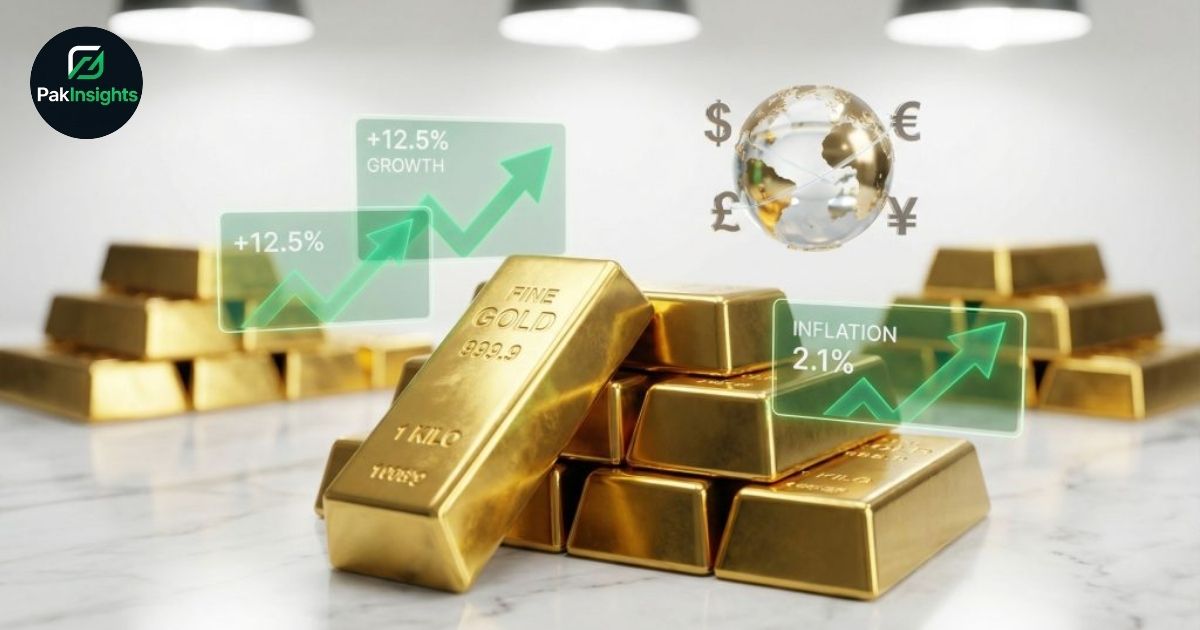
The gold market trends have captured global attention in 2025, and Pakistan is no exception. The year witnessed a historic gold rally and surge, transforming the metal from a simple inflation hedge into a safe-haven asset for investors. Gold prices soared across the world, driven by a mix of geopolitical tension, central bank gold accumulation, and increasing ETF inflows. Even as other markets struggled, gold maintained stability, drawing interest from institutional and retail investors alike. In Pakistan, cultural affinity for gold through jewelry and investment makes it even more significant, ensuring that gold as a safe-haven asset remains a top choice for financial security.
Global financial shifts also played a key role. The strengthening US Dollar (USD) and volatile equity markets pushed investors toward precious metals investment, while systemic risks and fiscal uncertainty fueled the metal’s appeal. Analysts noted that gold’s resilience during high real interest rates and gold sensitivity highlighted a structural shift. This year, gold proved its ability to weather economic storms, offering a blueprint for portfolio diversification with gold in volatile times.
2025 Gold Performance: Key Drivers and Market Insights
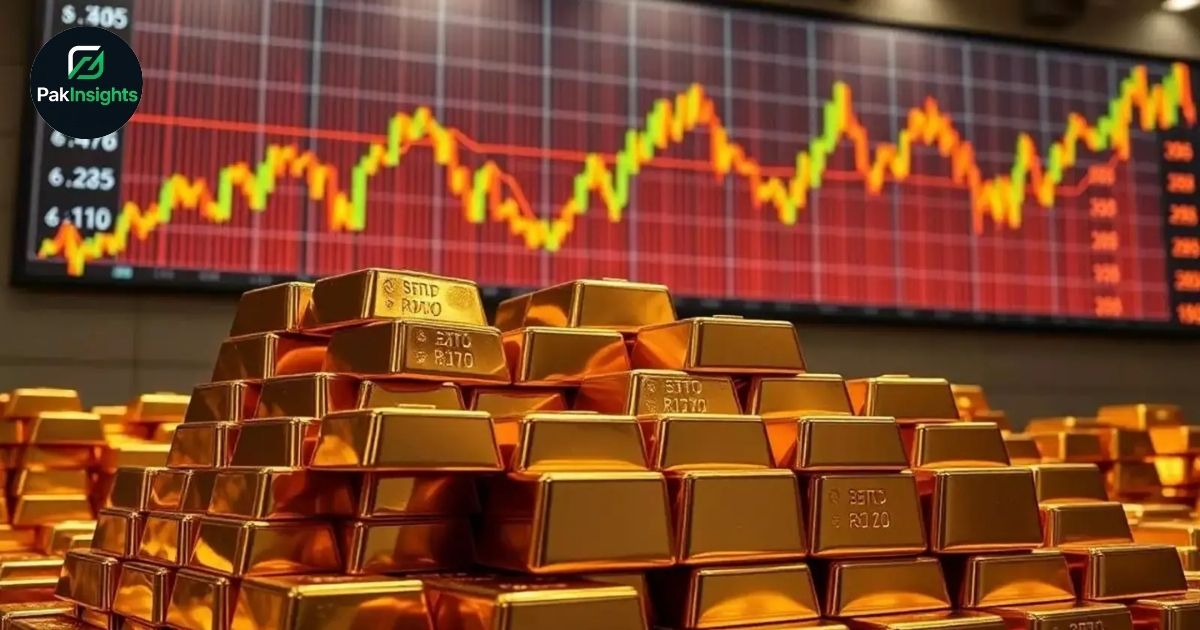
In 2025, gold (XAU/USD) saw unprecedented highs, reaching record levels above $4,300 per ounce. The surge was powered not only by inflation fears but by central banks (China, India, global reserves) buying aggressively, reinforcing gold’s long-term security. Physical gold demand (jewelry & industrial) also remained strong, with India’s wedding season and China’s cultural preferences supporting prices. Meanwhile, technology sectors continued consuming gold for semiconductors and electronics, ensuring consistent market liquidity. Investors recognized gold as a shield against systemic financial risk, especially amid geopolitical turbulence.
The year’s performance also highlighted unique market dynamics. Gold often moved alongside S&P 500 Stocks, defying traditional patterns where gold and equities usually diverge. Analysts cited concerns over US debt sustainability and broader geopolitical events (Israel-Hamas conflict, Eastern Europe, Middle East, East Asia) as drivers of this unusual co-movement. While assets like Bitcoin and stocks delivered higher returns, their volatility made gold the preferred choice for safe-haven portfolio allocation. Even US Treasury Bonds offered minimal protection, emphasizing gold’s comparative stability.
| Asset Class | YTD Performance 2025 | Key Feature | Correlation Insight |
|---|---|---|---|
| Gold (XAU/USD) | +17.4% to +50% | Lower volatility | Unusual co-movement with S&P 500 Stocks |
| S&P 500 Stocks | +23.8% | High returns | Broad hedge against systemic risk |
| Bitcoin | +94.7% | Extreme volatility | Represents high-risk appetite |
| US Treasury Bonds | +4.2% | Low yield | Negative correlation with gold |
| Oil (WTI Crude) | -8.3% | Underperformance | Decoupled from geopolitical risks |
Factors Shaping Gold’s Bullish Outlook in 2026
Looking ahead, the gold forecast for 2026 remains strongly bullish. Analysts expect monetary policy easing by the Federal Reserve, the Eurozone, and the Bank of England to lower real yields and weaken the US Dollar (USD), boosting gold’s appeal. Persistent geopolitical risk premiums and fiscal uncertainty will continue to support prices, making gold a core part of investment strategies. Global investors are likely to maintain high exposure as a hedge against potential instability.
Institutional forecasts also suggest strong growth. UBS, Goldman Sachs, Morgan Stanley, ING, and Deutsche Bank predict gold could reach between $4,400 and $4,900 per ounce. Analysts attribute this to sustained ETF inflows of gold, ongoing central bank gold accumulation, and concerns about political instability/trade tariffs/immigration policy worldwide. For Pakistani investors, these signals reinforce the need to monitor international trends while leveraging local market opportunities.
| Institution | 2026 Target | Key Drivers |
|---|---|---|
| UBS | $4,500 mid-year | Fed rate cuts, geopolitical risk, ETF demand |
| Goldman Sachs | $4,900 Dec | Sovereign purchases, strong ETF inflows |
| Morgan Stanley | $4,400 end-year | Falling USD, institutional buying |
| ING | $4,150 average | Central bank purchases, caution on liquidation risk |
| Deutsche Bank | $3,700–$4,000 average | Potential demand destruction, monetary trends |
Investment Strategies for Gold in 2026
Investors should focus on diversified gold investment strategies to maximize returns. Physical gold, digital platforms, and ETFs (Exchange-Traded Funds) all offer unique benefits. In Pakistan, combining jewelry and investment-grade gold ensures both cultural and financial security. Timing buys during minor price dips can increase long-term gains, while hedging against a weakening US Dollar (USD) preserves purchasing power.
Practical strategies also include monitoring gold recycling and mine production trends. Even if supply increases, strong demand from central banks and ETFs is likely to absorb extra volumes. Local investors should analyze gold’s global economic outlook, tracking inflation, interest rate expectations, and monetary policy easing to make informed decisions. By maintaining a strategic allocation, gold can remain a cornerstone of portfolio diversification with gold and a hedge against both systemic financial risk and global volatility.
Frequently Asked Questions
Q1: How did gold perform in 2025?
Gold experienced a historic surge in 2025, with gold prices 2025 reaching record highs due to central bank gold accumulation, ETF inflows, and global geopolitical risks.
Q2: What is the gold forecast for 2026?
Analysts predict a bullish gold outlook, with prices likely between $4,400–$4,900 per ounce, driven by monetary policy easing, systemic risk, and sustained institutional demand.
Q3: Why is gold considered a safe-haven asset?
Gold remains stable during market volatility and financial uncertainty, protecting investors from systemic financial risk and currency fluctuations.
Q4: What are the best gold investment strategies for 2026?
Diversifying between physical gold, ETFs (Exchange-Traded Funds), and digital gold platforms helps Pakistani investors hedge risks and preserve capital.
Q5: How do global events affect gold prices in Pakistan?
Geopolitical events and US monetary policy influence gold market volatility, making international trends critical for local investment decisions.
Meta Description
Gold Market Trends 2025–2026: Explore record-breaking prices, bullish outlook, and top gold investment strategies in Pakistan.