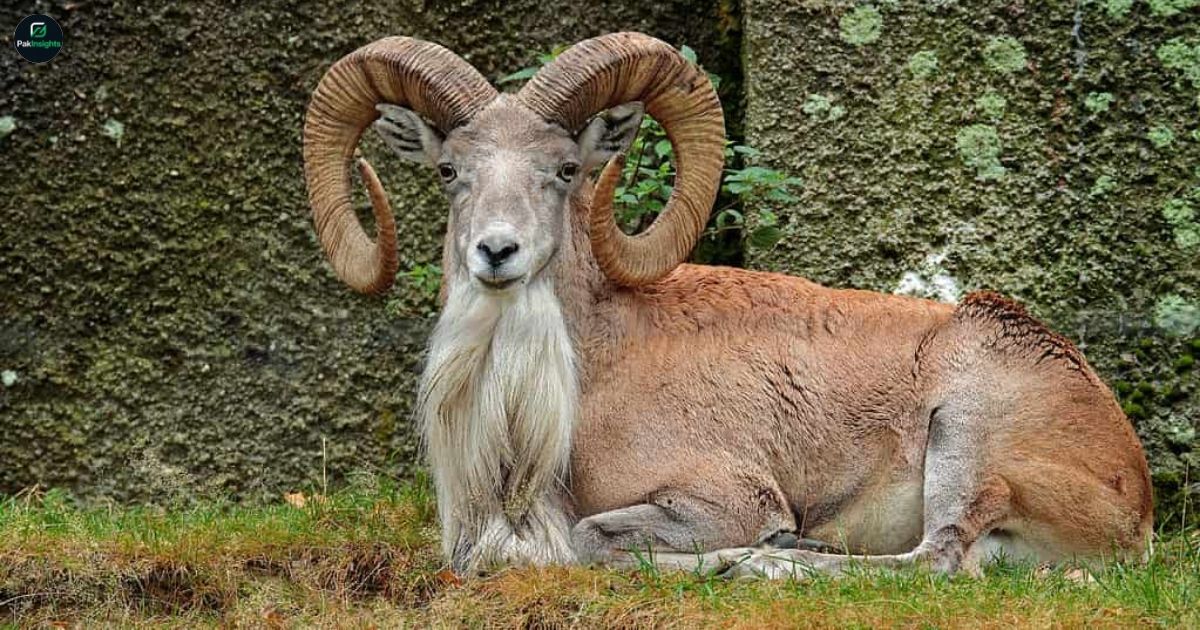
The Urial is a remarkable wild sheep species known for its curved horns and graceful agility. Native to the Pamir Mountains, Hindu Kush, and Himalayas, this majestic creature captures the imagination of wildlife enthusiasts across the globe. Scientifically classified as Ovis vignei, the Urial sheep belongs to the Caprinae subfamily of the Bovidae family, making it part of the broader group of Artiodactyla mammals. Often referred to as Arkars sheep or Shapo / Shapu sheep, these animals are a prime example of Asiatic wild sheep thriving in rugged terrains. Despite their beauty, Urial are listed as a Vulnerable species by the IUCN and appear in CITES Appendix I, reflecting their critical need for protection.
Unlike other South Asian wild sheep, the Urial has a unique social structure. Rams and ewes form small herds, and their interactions showcase the complex social behavior of wild sheep. Males boast large, impressive male urial horns, while females carry smaller, compressed female urial horns. Shoulder heights vary between 80 and 90 cm, and their agility allows them to navigate steep slopes with ease. This species is a vital part of the montane wildlife species and the fragile ecosystems of Central Asia.
What is a Urial? Species Overview and Identification
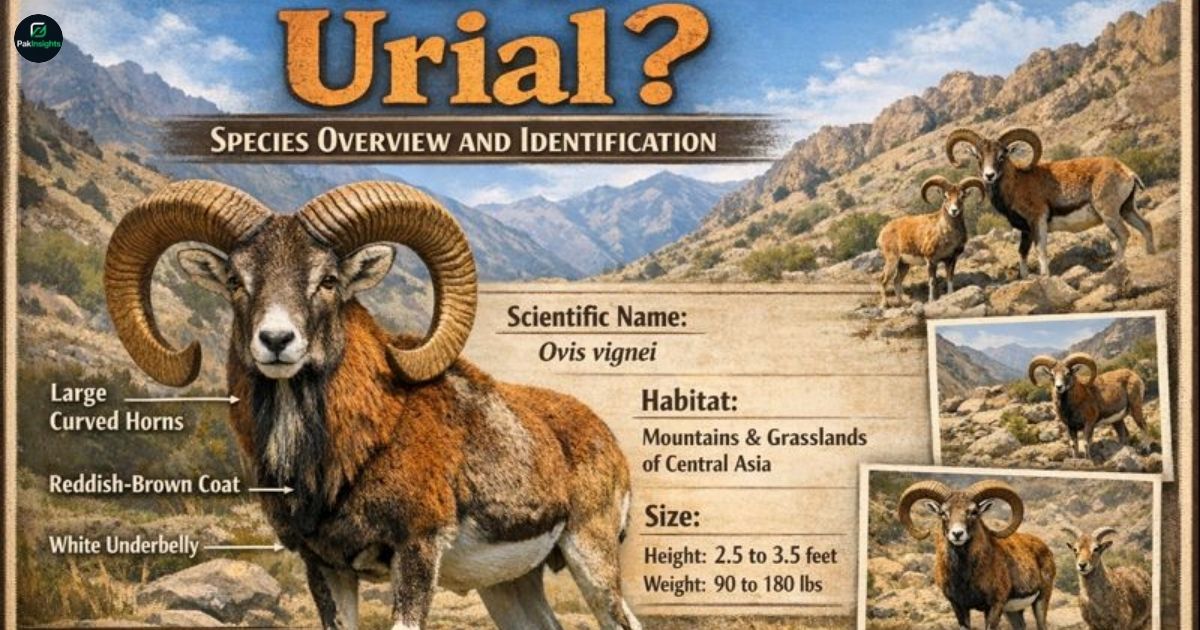
The Urial sheep is a medium-sized mountain sheep known for its curved horns and reddish-brown coat. Belonging to the Genus Ovis and Species Ovis vignei, it was first described by Edward Blyth, and its name honors Godfrey Vigne. There are six recognized subspecies of urial, including the Punjab urial, Balochistan urial, Ladakh urial, Transcaspian urial, Bukhara urial, and Afghan urial. Each subspecies has subtle variations in horn size, coat color, and habitat preference. Urial differ from other Central Asian wild sheep like the markhor, as their horns spiral outward rather than corkscrewing tightly.
Identification involves observing male urial horns, which can grow up to 100 cm, and the smaller female urial horns. Their shoulder height and body mass are distinct among South Asian wild sheep. Observers also look for behavior patterns, such as the herd dynamics of Rams and ewes, and the timing of the mating season. Understanding these traits is crucial for wildlife researchers and helps maintain accurate records in protected wildlife areas.
Natural Habitat, Geographic Range, and Behavior
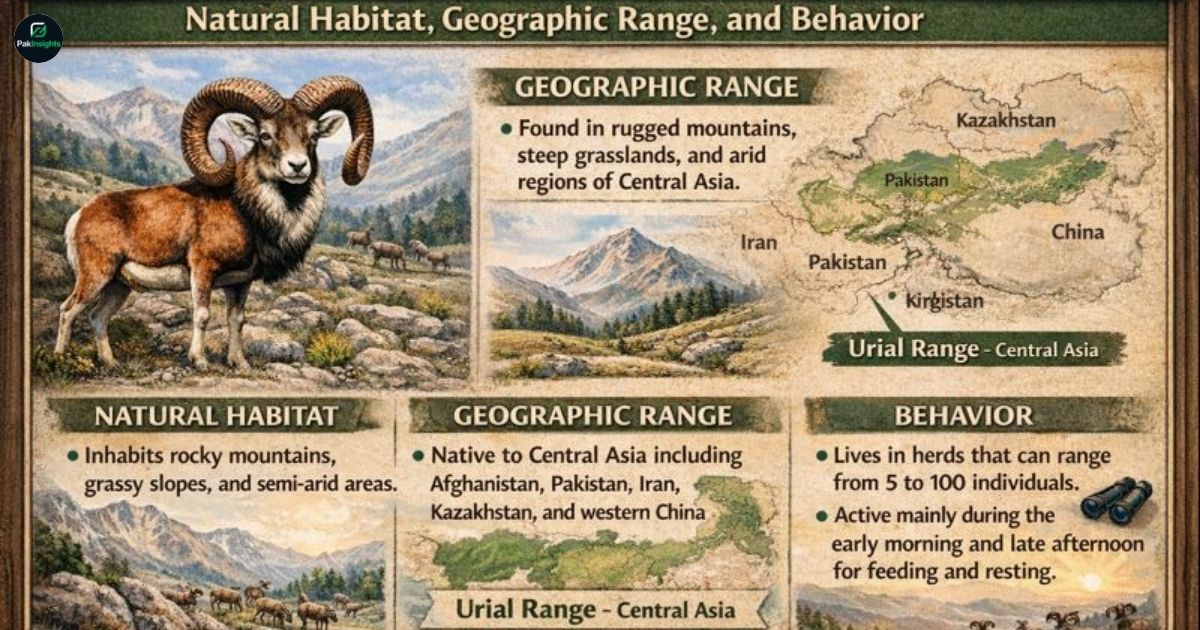
The Urial inhabits rugged terrains across Northern Pakistan, Ladakh and Kashmir, Balochistan, and stretches into Southwestern Kazakhstan. It thrives in montane grasslands, open woodland habitats, and even cold arid zones where few other species can survive. These mountain sheep adapt to extreme temperatures and can climb steep slopes to escape predators. Their diet mainly consists of grasses, shrubs, and herbs, which they forage across large areas.
Behaviorally, Urial are social animals. Rams and ewes gather in small groups, and during the mating season, males compete to mate with several females. After a gestation period of five months, ewes give birth to a lamb, which they protect fiercely. Their ability to adapt to harsh environments, combined with keen survival instincts, makes them a fascinating example of montane wildlife species.
| Subspecies | Range | Notable Traits |
|---|---|---|
| Ladakh urial | India, Northern Pakistan | Smaller horns, lighter coat |
| Transcaspian urial | Turkmenistan, Uzbekistan | Strong build, darker coat |
| Balochistan urial | Balochistan, Pakistan | Adapted to arid zones |
| Bukhara urial | Uzbekistan, Tajikistan | Largest horn size |
| Afghan urial | Afghanistan, Iran | Highly agile in mountainous terrain |
| Punjab urial | Punjab, Pakistan | Provincial significance, smaller herds |
Conservation Status, Threats, and Protection Efforts

The Urial is classified as a vulnerable wildlife species on the IUCN Red List and is legally protected under CITES Appendix I. Despite this, illegal hunting and habitat loss remain major threats. Human activities like farming and urban expansion have reduced their natural range across Central Asia. Maintaining ecosystem balance requires active intervention from wildlife organizations and local communities.
Conservation efforts include the establishment of protected wildlife areas and biodiversity hotspots. Governments in Northern Pakistan, Balochistan, and Southwestern Kazakhstan have implemented wildlife corridors to ensure safe migration. Awareness campaigns and research studies have helped track population trends, while global support emphasizes the significance of wildlife conservation. Protecting Urial sheep is not only about saving a species but also preserving the delicate montane wildlife species ecosystem.
Frequently Asked Questions
Q1: What is a Urial?
The Urial is a wild sheep species (Ovis vignei) native to Central and South Asia, known for its large curved horns and social herd behavior.
Q2: Where do Urial sheep live?
They inhabit montane grasslands, open woodland habitats, and cold arid zones across Northern Pakistan, Balochistan, Ladakh, and Kashmir, and parts of Central Asia.
Q3: Are Urial endangered?
Yes, the Urial is a Vulnerable wildlife species on the IUCN Red List and is listed in CITES Appendix I.
Q4: What are the subspecies of Urial?
The main subspecies include Punjab urial, Balochistan urial, Ladakh urial, Transcaspian urial, Bukhara urial, and Afghan urial.
Q5: How do Urial reproduce?
During the mating season, rams compete for ewes, and after a gestation period of five months, ewes give birth to a single lamb.